In 10 years of service, my Golden Retrievers and I have visited hospice clients, hospital patients, school kids and patients in a state psychiatric hospital. The opportunity for a new venue came in the Spring of 2024, when I received a call from a psychologist at a medium-security federal prison for men in Sheridan, Oregon. She had read about our work and wondered if we would be interested in volunteering at their facility.
The idea was intriguing, and after months of screening (fingerprints, background check, applications and attestations), I was invited to volunteer orientation. 6 months after the initial phone call, Kimber and I made our 1st visit.
Picture a rural Oregon campus surrounded by vineyards and Christmas tree farms. Ignore the barbed wire and armed correctional officers, and the prison more closely resembles a community college than a facility housing drug dealers, sex offenders, murderers and white-collar criminals.
I didn’t know what to expect but was told we would attend 2 group therapy sessions with 8-10 prisoners (the term “persons in custody” isn’t used in this facility) and a “patio visit” outside the cellblock housing those being treated for mental illness, who were to be our primary clients. To my surprise, I learned there are a handful of inmates (called allies) without mental illness who choose to live with fellow prisoners being treated for mental health conditions.
As I was being processed through security, Dr. Erica Baxter briefed me on the first prisoner we would meet – a lifer named Larry who served as a custodian in the outpatient clinic. I learned that he would be excited to meet us: Larry hadn’t touched a dog in 30 years. Seeing us at the door, Larry dropped to his knees, and as he was hugging Kimber, we could see the tears on his cheeks. After a few minutes on the floor, Larry rose to his feet and ran water in a utility closet behind us, then stepped out with a bucket of clean water for Kimber.
Perhaps the most memorable interaction with a client occurred on our 2nd visit, when a young man in the group chose to share an anecdote about his last encounter with a dog. He was only 15 when a German Shepherd leapt at him, seemingly unprovoked. The teenager lifted his forearm in defense, but the dog savagely bit both his forearm and his face. He displayed the scars to the group.
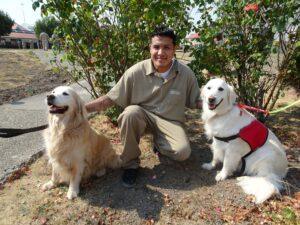
Attendance at the session was voluntary, so I asked the young man why he had chosen to attend, knowing a dog would be present. “Last month I passed by Kimber while she was greeting guys on the patio, and I could tell she was a gentle soul, so I decided to come today so I could see for myself.” While he was speaking, Kimber was sitting across the room from him, and as he told the story, Kimber rose to her feet, walked over to him, placed her muzzle in his lap, and remained with him for several minutes.
From my work with children, hospitalized patients, the mentally ill and hospice clients, I tell prospective therapy dog teams that you can expect small miracles nearly every day. This story is but 1 example.

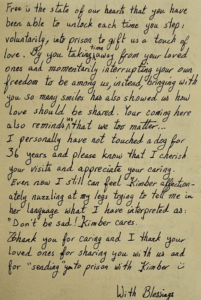
At our 3rd visit to the prison, inmates surprised me with 2 gifts: an 8-page handmade greeting card inscribed by 73 prisoners and a framed, hand-drawn portrait of Kimber. Both the drawing and the frame had been done by an inmate.
In addition to my work at Sheridan, I volunteer at a state psychiatric hospital which treats mentally ill persons accused of crimes. The other team at the hospital is a woman and her certified sheep-a-doodle. Neither of us has ever felt unsafe while working in either of these venues with accused or convicted persons. We’re thoroughly briefed on safety and are always accompanied by trained staff.
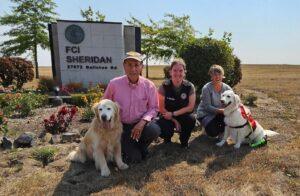
For months, I have been soliciting other teams to begin working with me in Sheridan. There was no response until recently, when 2 women volunteered: 1 with a golden retriever, the other with a lab-border collie mix. Handler Raven Pirisky is seen with her dog Jane in the photo, taken recently at the prison’s entrance.
The work we do honors the humanity of our clients, no matter who they are: rich or poor, housed or homeless, young or old, incarcerated or free. If volunteering in corrections interests you, contact the Federal Bureau of Prisons, your local jail or your state Department of Corrections. Like Kimber and I, you may be in for a very pleasant and rewarding surprise.
Eric Schuman, Alliance of Therapy Dogs Tester/Observer