By Tara Hoover, ATD Member
Learning What “Fit” Really Means
When I got my first therapy dog certified back in 2012, we began visiting a nursing home. At the time it was a popular place to volunteer, so I assumed that’s where we’d start.
It only took a couple of visits to realize I was wrong.
My pup, Juno, was a young, energetic Lab. The residents were older, many with fragile skin. The pace was slow, the rooms were quiet, and the energy mismatch was obvious. It wasn’t that she was badly behaved. It wasn’t that she didn’t love people. The environment was simply wrong for who she was, and pushing through it wasn’t doing anyone any favors.
A local hospital proved to be a much better fit. Busy hallways, constant foot traffic, new faces around every corner. Juno was in her element and thrived in a way she never had in those early nursing home visits.
Feeling confident in us as a team, I signed up for a therapy dog program at a local university – a weekly stress-relief event for college students. I was convinced we’d found our calling. Young adults with space to interact? She’d be great. This was going to be so fun!
But she failed the evaluation. The prerequisite test was held in the evening, and after a long day at home she had too much energy to perform the required skills. I pleaded. I promised she could do it, but the instructor held firm.
I was dejected. Embarrassed. Disappointed.
Turns out, that rejection gave me one of the greatest gifts of my therapy dog career – because I later found out how the program actually worked. The dogs were stationed around the room while students rotated through to visit them. Stationary. High excitement. Lots of crowding. Juno would have been miserable. The “no” I’d been fighting wasn’t a door closing. It was a correction.
That wake-up call forced me to stop thinking about what I wanted and start thinking about what was right for her. Where would she thrive, and what environments would let her be fully herself?
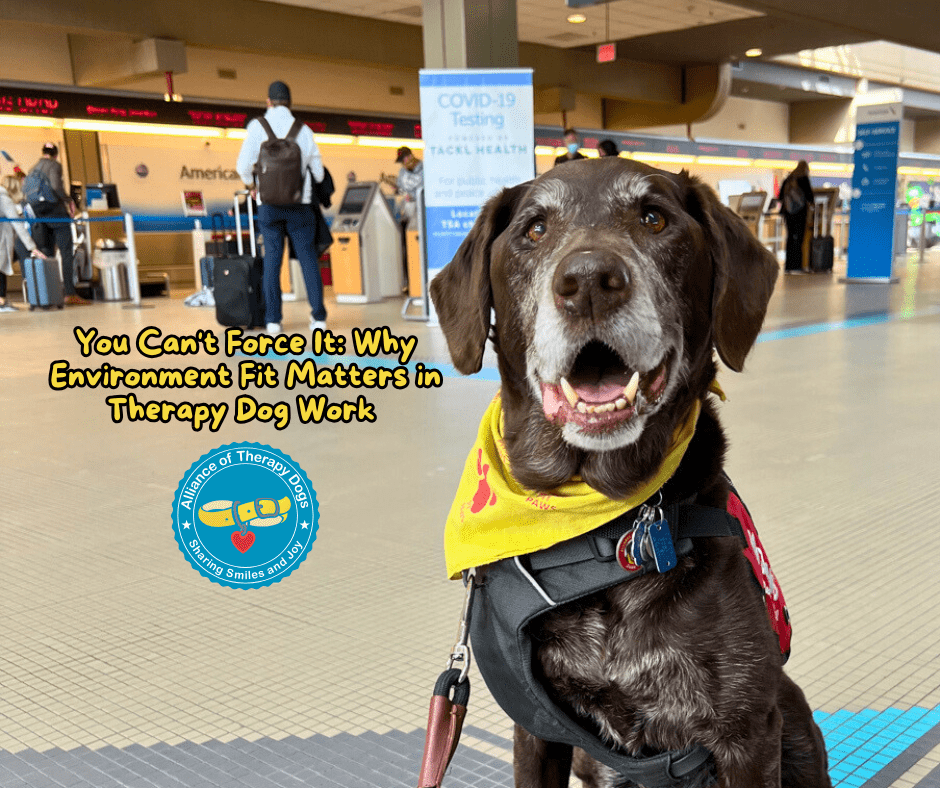
After a chance visit to our airport, I knew we found something special. Open space, constant movement, and an endless stream of strangers who all wanted to say hello. We were the first team to join PIT PAWS (Pups Alleviating Worry and Stress) at Pittsburgh International Airport in 2017 and proudly served for 6 years before Juno’s passing in 2023.

The Real Lesson: Fit Is Its Own Skill
Therapy dog certification tells you a dog can behave appropriately. It doesn’t tell you whether a dog will flourish – and flourishing is what makes this work sustainable, ethical, and genuinely helpful to the people you serve.
A dog who is merely enduring a visit isn’t a healing presence. The people you serve – patients, students, survivors, travelers – deserve a dog who wants to be there. That starts with an honest assessment of where your dog belongs.
Here’s how different environments tend to break down:
- Hospitals and healthcare facilities demand exceptional emotional steadiness. IV poles, medical equipment, strong odors, and sudden sounds are all part of the landscape. Dogs here need to be genuinely unbothered by unpredictability and find physical contact from strangers comforting – not just tolerable. Dogs who startle easily or who are anxious in novel environments aren’t a good match, regardless of how sweet they are at home
- Schools and libraries bring children: fast-moving, loud, sometimes clumsy with their affection. Dogs working in library programs or school counseling settings need to be completely unbothered by erratic movement and enthusiastic handling, and should be able to settle for quiet, extended contact. High-energy dogs who can’t hold still for a lap-read aren’t wrong – they’re just not right for this job
- Airports and transit hubs are uniquely demanding because of sheer sensory volume. Hard floors, echo, rolling luggage, crowds approaching from every direction. Dogs who work airports need to be genuinely crowd-comfortable – relaxed, not just tolerant -and adaptable to long stretches of standing and moving. High-drive dogs sometimes struggle here not because they’re difficult, but because the work doesn’t give them enough of an outlet. The best airport therapy dogs tend to have a naturally easy, meet-everyone temperament
- Memory care and assisted living facilities require patience and a very high tolerance for physical handling. Residents may grip too tight, pet repetitively, or not recognize a dog’s discomfort cues. Dogs who communicate quickly when they’ve had enough, or who have a lower threshold for handling, aren’t a good fit here – even if they’re exceptional in other settings
- Crisis response settings ask for something different entirely: a dog who stays grounded in emotionally charged, physically chaotic environments. This is specialized, high-stakes work, and it demands a temperament that goes beyond calm into something closer to truly unshakeable.
What the Wrong Environment Looks Like
It rarely looks like a disaster. More often it’s quiet: a dog who’s a little slower to approach, who yawns a bit more than usual, whose tail wags a little lower. A dog who is technically fine but not quite themselves.
Handlers who know their dogs well will recognize these signs. The harder question is whether we act on them – or whether we push through because we want a particular placement to work.
Rotating settings, shortening visits, or deciding that a specific environment isn’t the right fit isn’t failure. It’s the most responsible thing you can do for your dog and for the people your dog is there to serve.
The Conversation We Should Have More Often
We’re good at celebrating the dogs who thrive. We’re sometimes less good at talking openly about a mismatch – about the times a perfectly wonderful, certified, loving dog just doesn’t belong in a particular room.
That conversation matters. Because when you stop forcing fit and start following your dog’s lead, you might find yourself building something you never expected.
The “no” that can feel like failure is often a redirection to exactly where you’re meant to be.